
Testifying before a Mumbai court for the second day on Tuesday, Pakistani-American terrorist David Coleman Headley said LeT had planned to attack Indian defence scientists at the Taj Mahal Hotel in Mumbai and that he was asked by Pakistan's ISI to recruit Indian armymen to spy for them.
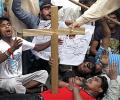
Two suicide bombers rammed into the All Saints Church in the Kohati Gate area of Peshawar, Pakistan, when Prime Minister Nawaz Sharif was on his way to New York to attend the United Nations General Assembly session.

Lashkar-e-Tayiba and the Al Qaeda were convinced that 26/11 attack masterminds Hafiz Saeed and Zakiur Rehman would face only "superficial" action from the Pakistani authorities and within months plans were afoot for another terror strike in India, Pakistani-American terrorist David Coleman Headley said on Saturday.

At the largest international stage -- the UN General Assembly-- External Affairs Minister Sushma Swaraj sent out a stern message to Pakistan Prime Minister Nawaz Sharif, saying, "Talks and terror cannot go together".
A Mumbai court on Thursday pardoned Pakistani-American Lashkar-e-Tayiba operative David Headley, who had surveyed targets for the 26/11 attacks, and made him an approver in the case, a move that may unravel the conspiracy behind the brazen terror assault.

'By beheading an Indian soldier, the Pakistan army has demonstrated its proclivity for barbaric medievalism.' 'The strategies adopted and the punishment inflicted by India must be made progressively more stringent with every new act of terrorism till the cost becomes prohibitive for Pakistan,' says Brigadier Gurmeet Kanwal (retd).

'His secretary of defence nominee, General James Mattis, says he expects Pakistan to take action against terrorists operating from its soil.' 'Any pressure the US can bring on the Pakistani regime terror-wise would pay dividends for India.'

'An operation such as the Mumbai attacks, which needed expert technical assessment, money and time to prepare, could not have been carried out without the knowledge of the ISI's leadership.'

Experts trace the reasons for the 26/11 attacks to the Pakistan's military interest in three key areas: Kashmir, Afghanistan and nuclear armaments.

'He knows India is going nowhere.' 'India will never let go of Kashmir, so he wants to settle with India.' 'Settle honourably with peace, dignity and justice.'

Saroj Kumar Rath, author of the newly-published book Fragile Frontiers: The Secret History of Mumbai Terror Attacks, speaks to Rediff.com's Vicky Nanjappa.

What Headley's testimony does achieve is expose the Congress' ham-fisted attempts to taint an otherwise credible probe. That, however, does not become an assertion of Ishrat's membership of the LeT.

'For a long time Pakistan dreamt that India would break up and that it would be the predominant power in the region,' says Colonel Anil A Athale (retd).

Girls in the Kashmir valley hurling defiance at the security forces will detract from the legitimacy of India's response and its standing in the world, says Ajai Shukla.

How to deal with a country that has made export of terror a reason to make the world notice and fund it? Rediff.com contributor Sanjeev Nayyar offers a few suggestions

Border Security Force on Monday said repeated ceasefire violations across the border in Jammu and Kashmir are being done at the behest of Pakistan to facilitate infiltration of "undesirable" elements into Indian territory.
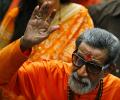
Pakistani-American terrorist David Headley, convicted in the US for his role in the 26/11 Mumbai attacks, on Thursday told a court in Mumbai that terror outfit Lashkar-e-Tayiba wanted to eliminate Bal Thackeray but the person who was assigned the job to kill the late Shiv Sena chief was arrested.

India questioned the functioning of Pakistan's notorious military courts.

'As Mumbai showed, and the Nairobi Westgate Mall attack reinforced, "guerrilla-style terrorism" has increasingly become the method-of-choice for terrorist groups,' says terrorism expert David Kilcullen.
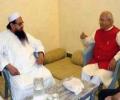
'There are all sorts of characters moving around acting as unofficial representatives of the government and engaging in their own personal foreign policy initiatives. Clearly, the government needs to shut these characters down if it wants to continue enjoying any credibility, both domestically and internationally,' says Sushant Sareen.

'How can Kashmir be demilitarised if the terrorist threat remains and Pakistan continues to incite elements in Kashmir to keep the internal situation unstable?' asks former foreign secretary Kanwal Sibal.

'When it comes to India-Pakistan relations, seminal moments of progress invariably bring out saboteurs of peace -- whether we're talking about fresh provocations along the LoC, or even a terror attack in India.'

'India has to judge what Pakistan says to us, not what they say to a domestic audience,' a source tells Sheela Bhatt/Rediff.com, explaining why India-Pakistan talks remain on track despite discordant noises from across the border.

The sea training also included 'how to fish', something that made Kasab think that 'he had got a job and he could earn a respectable living'.

'Pakistan persists in the belief that such attacks will enable it to obtain the territory it covets. Their plans will not succeed.'

King Salman and Narendra Modi will find common ground to intensify cooperation against jihadi terrorism, says Tarun Vijay, MP.
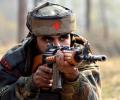
How will India respond to an attack which keeps haemorrhaging India but stays below the threshold of tolerance?
'Pakistan is convinced that the Modi government has -- given its image and political compulsions -- no choice but to act in the case of another terror attack.'

'The clique that runs that country is treating us like suckers. We are very foolish, giving people money who involve themselves in activity that's harmful to America.' 'When you look at the cold hard facts, Pakistan is not an ally to the United States. They have facilitated, they have encouraged, they have been a protector of enemies.'
'There is hope that in the next 48 to 72 hours there will be some kind of movement forward to de-escalate and not heighten the tension.'

'What we need from the civilian and military authorities are clear strategies rather than an emotional decision to hang terrorists on death row.'

The clichd path of conducting 'uninterrupted and uninterruptable' bilateral dialogue with Pakistan to improve ties remains unimplemented and un-implementable under prevailing circumstances that are unlikely to alter in the near future, says Rahul Bedi.

After weighing all the costs and benefits, the next administration is likely to reduce and restructure assistance to Pakistan but not to end it altogether, says Daniel S Markey.
'A conventional war is not in fashion today and not seen as being able to deliver the objective.' 'Perhaps surgical strikes that are deeper, this time not on Pakistan's terrorist facilities, but on Pakistan army facilities.' 'The nation has to be prepared for losses.' 'War is not something that can be pussyfooted around.' 'If we go for limited number of posts in Kashmir, these are very difficult posts to capture and very difficult operations.' 'Be prepared for 200 to 300 killed.'

Countries in the region like Afghanistan, Pakistan and Maldives face serious existential threats from a mix of terrorist groups active in the region and elsewhere
Pakistan's 'approach is one of getting even, an eye for an eye, or death by a thousand cuts.' 'The entire effort is to be the equal of India. Unfortunately, the reality is that this can never be the case.' 'India will always be the bigger, economically stronger, technologically more self-reliant country.' 'Therein, lies the dilemma Pakistan faces which leads it to perennial enmity with India,' notes Ambassador Gautam Bambawale in the Air Marshal Y V Malse Memorial Lecture 2019.

The question really is whether the US can be persuaded to embark on a path of calibrated and stronger sanctions on Pakistan.

'Checkmating India by its nukes, Pakistan can pursue terrorism against India in the Kashmir Valley and also resume launching Mumbai 2008 style attacks.' 'The military oligarchy in Pakistan has a totally different view of what is desirable and possible in the subcontinent.'

'A new doctrine now needs to be evolved for a new situation, and the army will do it.' 'You won't see more Kashmiris driven in front of army columns.' 'Nor will the army massacre hundreds, Dyer style,' says Shekhar Gupta.

The Pampore attack in Jammu and Kashmir "appeared to be" the handiwork of Lashkar-e-Tayiba terror outfit, Central Reserve Police Force Director General Prakash Mishra said.
